Curved-roof playground canopies
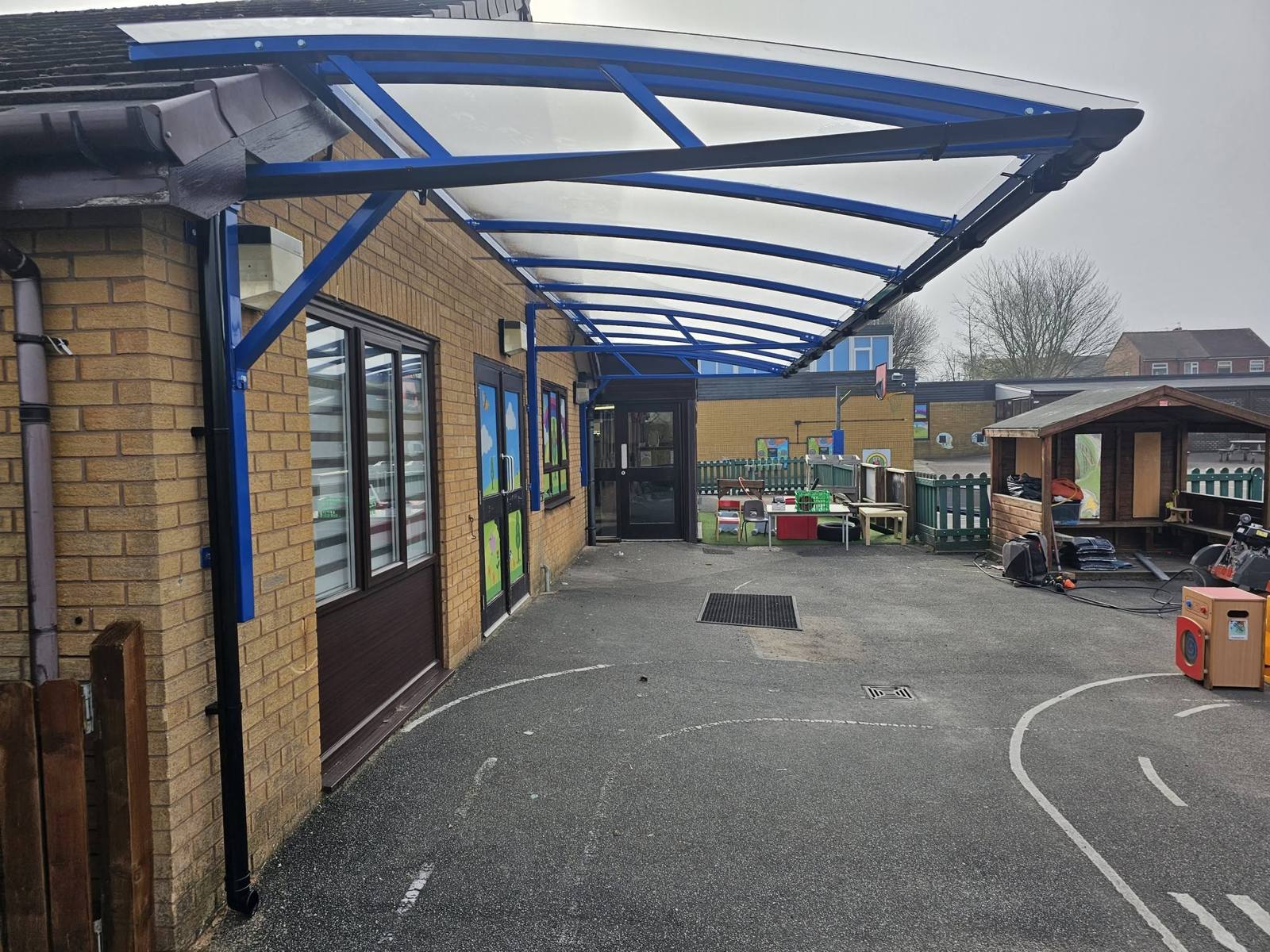
A curved-roof canopy swaps the straight mono-pitch for a gentle arch. It lifts a building frontage, sheds weather cleanly across a wider span and gives a more finished, premium look for a main entrance or a flagship play area.
- Barrel / arched roof
- Self-draining
- Wide clear spans
- Powder-coated steel
What is a curved-roof playground canopy?
A curved-roof playground canopy is a permanent, powder-coated steel structure with an arched (barrel) roof glazed in impact-resistant UV-filtering polycarbonate, installed over a school or public play area for year-round shade and rain shelter. It is one of the roof forms behind our playground canopies, chosen for its open feel and self-draining arch.
The curved (barrel) roof sheds rainwater across the whole arch rather than running it to one straight edge, and its rising profile lifts headroom over the centre of the space, so the covered area feels more open. Built on the same galvanised, powder-coated steel platform as a straight-roofed canopy, it is a look and drainage choice, not a compromise on strength.
- Roof form: curved (barrel) arch that self-drains across its whole span.
- Frame: galvanised then powder-coated steel, low-maintenance and long-lived.
- Roof glazing: impact-resistant polycarbonate that filters roughly 99% of UV.
Mono-pitch or curved roof — which is better?
Neither roof is better outright: a mono-pitch (straight) roof is the efficient, economical default that drains to one low edge, while a curved-roof playground canopy sheds water across the arch, lifts central headroom and gives a more premium, open frontage. The right choice depends on the span, the look and the budget. See the same comparison on our steel playground canopies page.
| Mono-pitch (straight) | Curved (barrel) | |
|---|---|---|
| Drainage | To one low edge | Sheds across the arch |
| Headroom | Even, single slope | Lifted over the centre |
| Span & feel | Efficient, economical | Wider, more open |
| Look | Clean and simple | Premium frontage |
| Cost | Lowest | A little higher |
Both roof forms are built on the same powder-coated steel platform and glazed in polycarbonate; the choice is about drainage, headroom, look and budget, not strength.
How much does a curved-roof playground canopy cost?
A curved-roof playground canopy is quoted to your project rather than sold at a list price, because the cost is driven by the span, the height, the roof specification, the groundworks and the fixing. We survey the site, then return a design, a specification and a firm price with no obligation.
The biggest cost movers are the covered area and clear span (more steel and bigger foundations), the roof glazing on the polycarbonate canopies spec, ground conditions and access, and any powder-coat colour or extras such as guttering and downpipes. A curved (barrel) roof carries a little more forming than a straight steel playground canopy, which we set out clearly in the quote.
Should a curved-roof canopy be free-standing or wall-mounted?
A free-standing curved-roof canopy stands on its own columns out in the play area, while a wall-mounted version fixes to the building for column-free cover right outside the doors. The choice for a curved-roof playground canopy comes down to whether there is a suitable wall to lean on and how the space is used.
- Free-standing: best out in a playground, field or MUGA, where the arch is seen from all sides and no wall is close.
- Wall-mounted: best against a classroom or hall wall, keeping the covered space clear of columns.
Can a curved-roof canopy be made in our school colours?
Yes: the steel frame of a curved-roof playground canopy is powder-coated to any RAL or school colour at no structural compromise, so the canopy can match a school’s branding or sit quietly against the building. The polycarbonate roof is specified separately, clear for brightness or opal to diffuse the light across the arch.
What standards apply to a curved-roof playground canopy?
The structure of a curved-roof playground canopy is engineered to the structural Eurocodes — BS EN 1991 for wind and snow loads, BS EN 1993 for the steelwork — with load calculations, and installed under CDM 2015. It is designed and fitted to serve primary and secondary schools and councils, parks and play areas alike.
Note that BS EN 1176 governs the play equipment and impact surfacing a canopy shelters, not the shelter structure itself, so we never claim the canopy “complies with BS EN 1176”. Our installers are DBS-checked for work on a live school site.
Self-draining arch
The curve sheds rain and debris without relying on a single low edge.
Wide clear spans
A stronger roof profile covers bigger open areas with fewer columns.
Frontage appeal
A softer line that lifts an entrance or a headline play space.
Recent installs
Discuss your site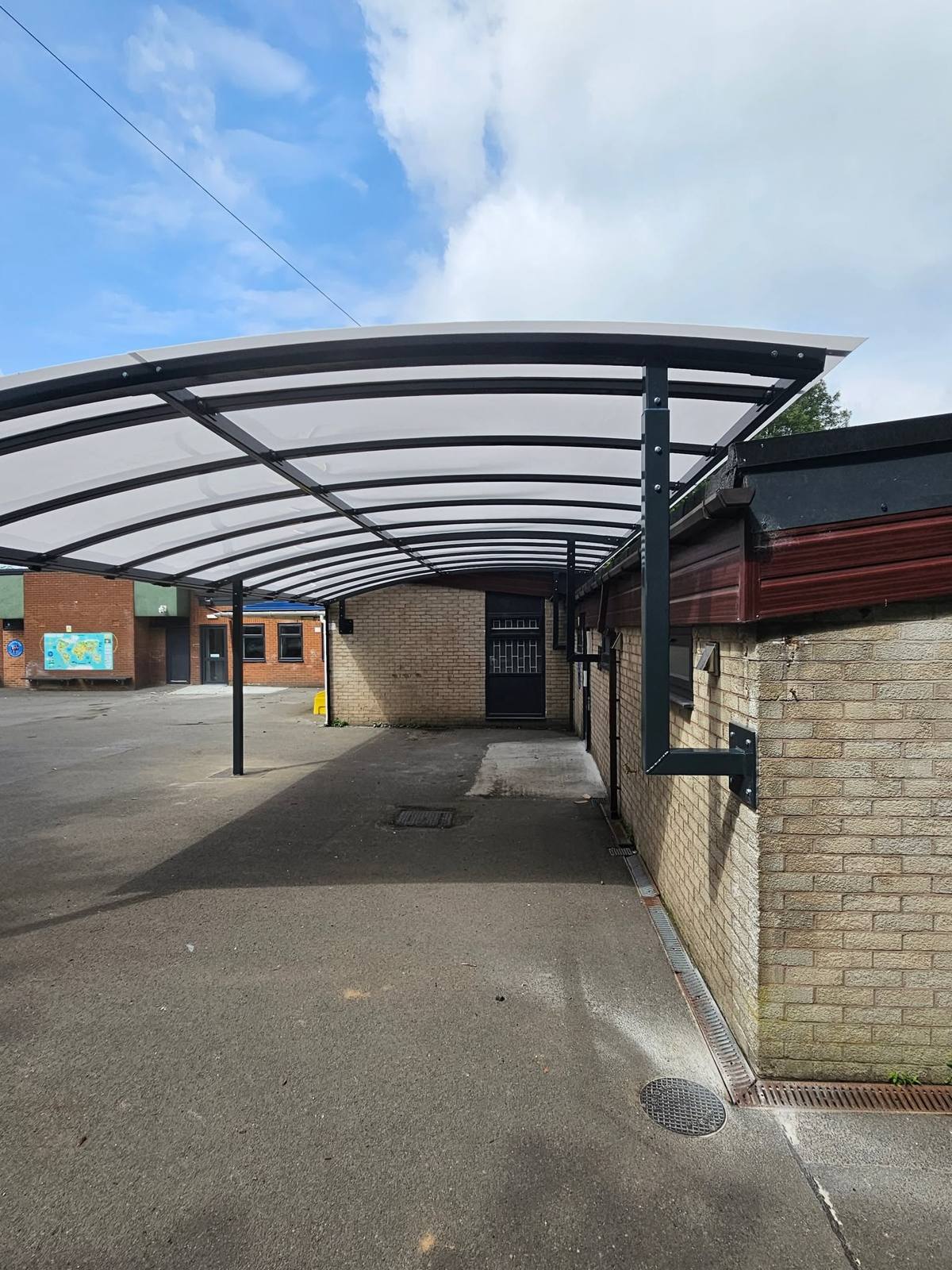
Curved-roof playground canopies questions
Does a curved roof drain better than a straight one?
A curved (barrel) roof sheds rainwater across the whole arch rather than to a single low edge, and we detail guttering and downpipes to carry that water away cleanly. Both roof forms are engineered to the same wind and snow loads, so drainage is a design preference, not a strength difference.
Is a curved-roof canopy more expensive than a mono-pitch one?
A curved (barrel) roof usually costs a little more than a straight mono-pitch roof because of the extra forming, but the span, roof specification, groundworks and fixing move the price far more than the roof shape. We quote both to your project so you can compare like for like.
Fully insured
Comprehensive cover on every project.
Engineered to the Eurocodes
Structural design under BS EN 1991/1993/1995 and CDM 2015.
UK-manufactured
Made in our own UK workshops, fitted by our own teams.
Structural guarantee
Frame and roof warranties confirmed with your quote.
Get a curved-roof playground canopies quote
Tell us the setting, roughly how big the area is and what you want it to do. Our design team comes back with a drawing, a specification and a price, with no obligation.